Binary to HEX
Instant Translation from Machine Code to Human-Friendly Hex Values

Trying to read a long string of bits from a data log or a memory dump? Our Free Binary to Hex Converter simplifies the process by grouping bits and translating them into concise Hexadecimal (Base-16) notation. In 2026, where data-heavy fields like AI and blockchain rely on efficient data representation, being able to quickly compress binary into Hex is a vital skill.
Whether you are a computer science student learning about nibbles and bytes, or a software engineer mapping out memory addresses, our tool provides 100% accurate results. It handles long binary strings, automatically groups them into 4-bit sections, and outputs clean Hex values (A-F).
Technical Features of Our Binary to Hex Tool:
-
Auto-Padding: Automatically adds leading zeros to complete 4-bit groups.
-
Grouping Options: Outputs Hex with or without spaces and "0x" prefixes.
-
High Capacity: Processes massive binary strings for firmware analysis.
-
Input Sanitization: Ignores spaces or dashes within your binary input.
-
100% Free & Secure: No data leaves your browser at HelpingWebTools.com.
How do I convert Binary to Hex?
To convert manually, you group the binary digits into sets of four (starting from the right). Each group of four is called a nibble. You then match each nibble to its Hex equivalent (0–9, A–F). Our tool automates this entire process for you instantly.
Why is Hex used instead of Binary in programming?
Binary is extremely long (8 bits just for one character). Hex is much more compact; 2 Hex characters can represent an entire byte (8 bits). This makes it significantly easier for developers to read memory addresses and color codes.
What happens if my binary string isn't a multiple of 4?
Our tool uses Auto-Padding. It adds zeros to the beginning of your string to ensure the groups are complete, preventing calculation errors.
Can this tool convert Binary to Hex color codes?
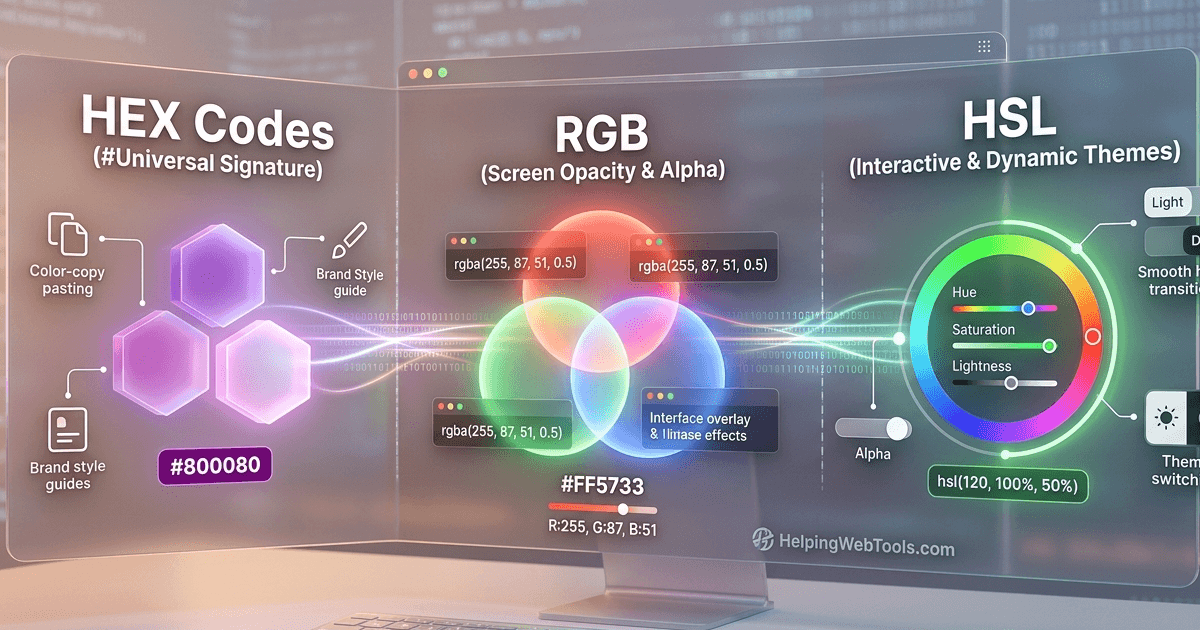
Yes! If you have a 24-bit binary string representing a color, our tool will give you the 6-digit Hex code (e.g., FFFFFF for white).
Does it support the "0x" prefix?
Yes! You can choose to have the output formatted with the 0x prefix, which is the standard notation used in languages like Python, C++, and Javascript.
Popular Tools
Recent Posts