Decimal to HEX
Fast and Accurate Base-10 to Base-16 Translation for Technical Projects


Need to represent a large number in a more compact format? Our Free Decimal to Hex Converter is the premier choice for translating standard Base-10 numbers into Base-16 (Hexadecimal). In 2026, as we deal with increasingly large data sets in blockchain and AI, Hex remains the industry standard for making binary-related data human-readable.
Whether you are converting a color value like 255 to FF, or working with large system offsets, our tool provides an instant result. It supports standard integers, large 64-bit values, and offers formatting options like the "0x" prefix commonly used in programming languages like C, Python, and JavaScript.
Technical Features of Our Decimal to Hex Tool:
-
Prefix Customization: Toggle between raw hex,
#(CSS), and0x(Programming). -
Case Selection: Choose between Uppercase (AF) and Lowercase (af) output.
-
Large Number Capacity: Handles values ranging from 0 to trillions.
-
Real-Time Results: No clicking required; results appear as you type your decimal value.
-
100% Free & Secure: All logic is processed on the client-side at HelpingWebTools.com.
How do I convert Decimal to Hex? The most reliable method is Repeated Division by 16. For example, to convert 158:
-
158 ÷ 16 = 9, remainder 14 (E)
-
9 ÷ 16 = 0, remainder 9 Reading bottom to top: 9E. Our tool automates this division process for you instantly.
Why does Hex use letters instead of just numbers? Because Hex is Base-16, we need 16 unique symbols. Since we only have digits 0-9, we use A, B, C, D, E, and F to represent the values 10, 11, 12, 13, 14, and 15.
What is the "0x" before a Hex number? The 0x is a prefix used in computer programming (like in Java or C++) to signify that the number following it is in Hexadecimal format rather than Decimal. Our tool allows you to include this automatically.
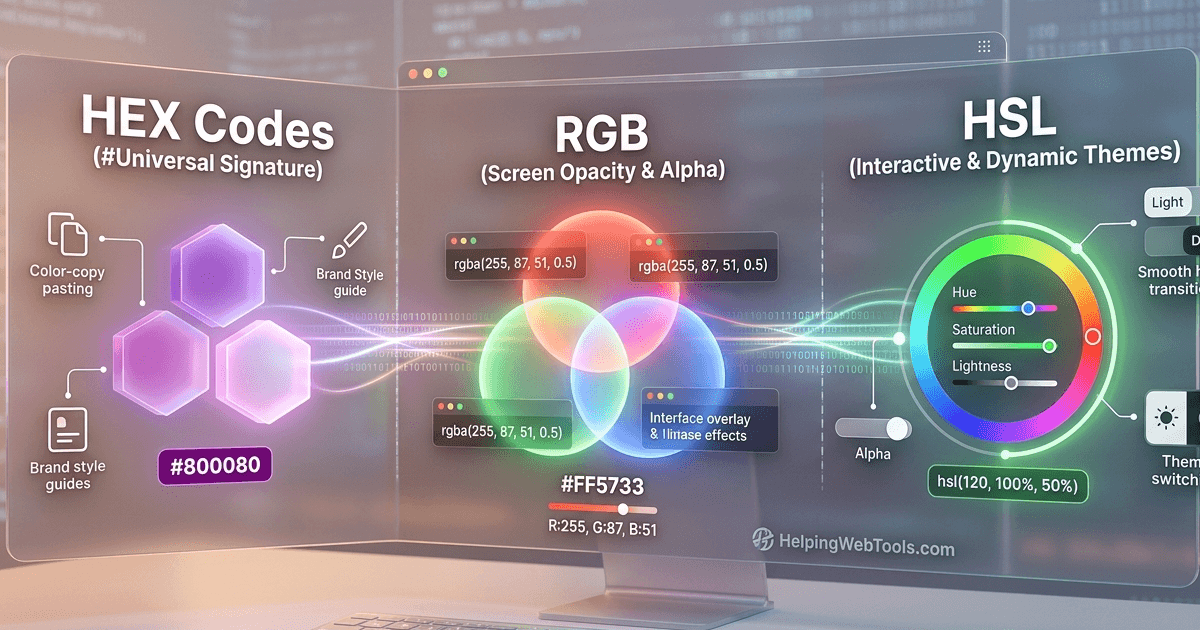
Can this tool help with CSS colors? Absolutely! CSS colors use hex codes. For example, if you know a color's Red value is 255, Green is 87, and Blue is 51, you can convert each to hex (FF, 57, 33) to create the hex code #FF5733.
How many bits are in a Hex digit? One Hexadecimal digit represents exactly 4 bits (also known as a "nibble"). This is why Hex is so popular in computing—it maps perfectly to binary data.
Popular Tools
Recent Posts